
You’ve noticed some wood damage in your basement. There are small piles of sawdust near your foundation. Maybe you’ve spotted some insects crawling around your home’s wooden structures. Your first question is probably: Do I have termites or carpenter ants? This question matters significantly because the answer determines how you should respond and how urgently you need to act.
Termites and carpenter ants both damage homes differently and need distinct treatment methods. The challenge is that many homeowners confuse the two because they both damage wood. However, understanding the distinctions between these pests is crucial for protecting your property.
Let’s explore how to identify which pest you’re dealing with and what to do about it.
Understanding the Difference Between Termites and Carpenter Ants
In the debate around termites vs. carpenter ants, we have more pronounced differences than you might think. While both insects are attracted to wood and can cause damage, they’re fundamentally different creatures with distinct behaviors, lifecycles, and damage patterns. Knowing these differences helps you take appropriate action quickly.
The confusion is understandable because both insects are found in homes, both are attracted to wood, and both can be difficult to spot. However, they belong to completely different insect families, which explains why their behavior and the damage they cause are distinct.
Physical Appearance and Identification
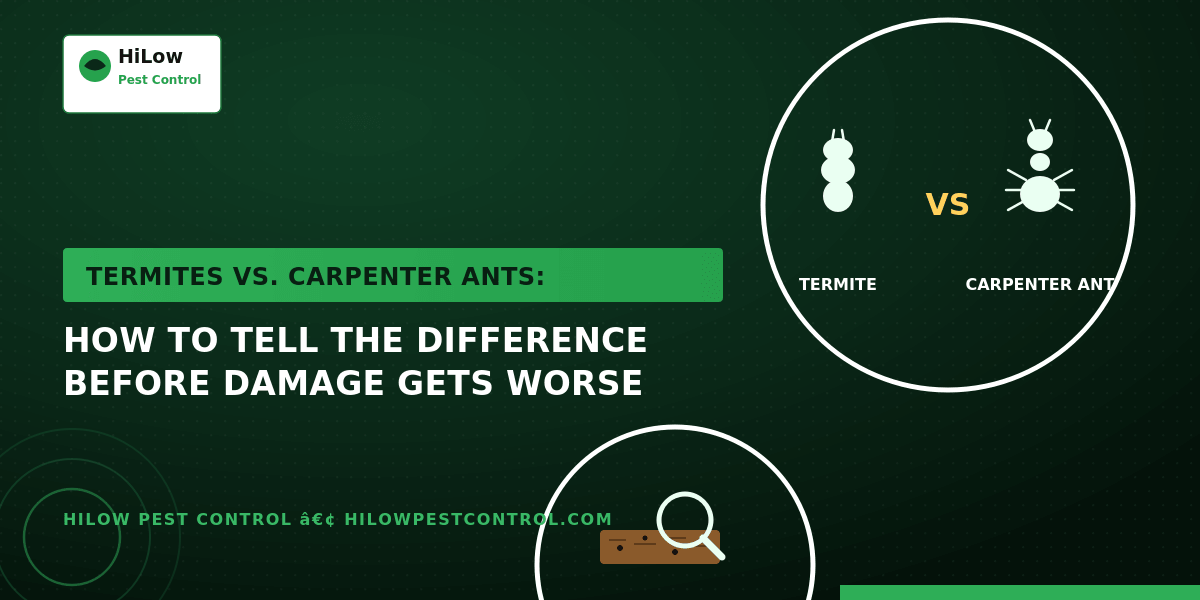
The easiest way to distinguish between these pests is by their physical traits. Carpenter ants have a segmented waist, making their bodies appear pinched, and are usually dark brown or black, measuring about one-quarter to half an inch. Termites lack a visible waist, have a more uniform, thicker body that ranges from cream to light brown, and are generally smaller, with size varying by species.
Termites have wings of the same size and shape beyond their abdomen; winged carpenter ants have differently sized front and rear wings. These physical differences become obvious once you know what to look for, making identification relatively straightforward when you have a specimen to examine.
Behavioral Differences That Matter
Beyond appearance, these insects behave differently. Carpenter ants are social, opportunistic scavengers that tunnel through wood to nest, and are mainly active at night and during warmer months. They don’t eat wood but create galleries. Termites, unlike ants, consume wood by breaking down cellulose, leading to faster, more catastrophic damage. They are also highly organized, with some colonies having hundreds of thousands of members working together.
Another critical behavioral difference involves moisture. Carpenter ants prefer moist areas, which is why you often find them in water-damaged wood, around leaking pipes, or in humid basements. Termites can damage wood in drier conditions, depending on the species, even though they prefer moisture. Subterranean termites, for example, maintain moisture by staying underground and traveling through mud tubes they construct.
Termite Identification Guide: What to Look For

A solid identification guide starts with understanding which types of termites might be present in your area and the evidence they leave behind. There are three main termite types: subterranean, drywood, and dampwood, each with distinct traits and damage patterns.
Subterranean termites are the most common and destructive, living underground and building mud tubes to access above-ground wood. Drywood termites infest dry wood and form galleries without soil contact. Dampwood termites are rarer in developed areas and usually infest wood with high moisture content.
Types of Termites in Your Area
Knowing your termite type is crucial for treatment. Mud tubes, signs of subterranean termites, are found on exterior walls, foundations, basements, or crawl spaces. These mud-and-saliva tunnels connect underground colonies to food sources.
Drywood termites leave piles of pellet-like droppings called frass, often beneath infested wood. These are early signs of activity and may appear on windowsills, attic floors, or near furniture.
Dampwood termites, though less common, usually affect only very damp wood. Finding them in your home indicates a serious moisture issue requiring attention alongside termite control.
Common Termite Signs
Several clear signs indicate termites in your home. In addition to the mud tubes and frass mentioned above, look for hollow-sounding wood, sagging floors or ceilings, and blistered or bubbling paint. Termites eat wood from the inside out, so the surface often appears intact even though the interior is completely hollowed. You might also hear creaking as termites chew through structural wood, or notice a musty odor in heavily infested areas.
Swarmers, winged reproductives emerging seasonally to start colonies, are key signs. Flying ants with equal-sized wings may be termite swarmers. Indoor sightings clearly indicate termite presence.
Carpenter Ants vs Termites Damage: Key Distinctions
Understanding the differences in how these pests cause damage is critical for determining which pest you’re dealing with and how serious your situation is. The type of damage they create tells a story about their behavior and feeding habits.
How Carpenter Ants Damage Structures
Carpenter ants tunnel through wood to nest, but don’t eat it, so damage is mainly at nests. Large colonies can cause significant harm over time. Their tunnels are smooth and resemble hallways. Unlike termites, they leave sawdust-like shavings outside galleries.
Carpenter ant galleries are usually in damaged, water-logged, or decaying wood because it’s easier to tunnel through. They can also nest in sound wood if protected from moisture. The damaged wood often remains structurally sound within the gallery because ants create living spaces rather than consuming the material.
How Termites Damage Structures
Termite damage is often more extensive and faster because they continuously consume wood. They create honeycomb-like galleries following the wood grain, eating out the softer parts. Damage extends throughout the infested wood, not just in isolated areas.
A comparison between carpenter ants vs termites damage reveals that termite damage compromises structural integrity much more rapidly. A thriving termite colony can consume substantial amounts of wood within months.
Additionally, termites can affect much larger areas of a home because they establish extensive underground colonies that can encompass multiple feeding sites throughout the entire structure.
Signs of Termite Infestation: Interior and Exterior

Recognizing signs of termite infestation means understanding where and how to look for evidence. Termite damage doesn’t announce itself loudly; it develops silently until the damage becomes severe.
Indoors, check for buckled paint, soft wood, mud tubes, and clicking sounds inside walls, especially in basements and crawl spaces. Inspect the foundation for cracks, as termites can enter through small openings.
Outdoors, inspect your foundation thoroughly for mud tubes. Check wood elements like decks, pergolas, and sheds for damage or soft wood. Look for mud tubes on tree trunks, fence posts, and other structures. Examine around your home for termite signs, especially in shaded, moist areas.
Carpenter Ants: What to Look For
Identifying carpenter ants differs from termites. You’re more likely to see them, especially at night, as they are more active. Look for large black ants on wood, walls, or wires, particularly in kitchens and bathrooms, which may indicate a possible infestation.
Carpenter ants leave sawdust-like shavings, often found beneath damaged wood. Unlike termite frass, which is round and uniform, these shavings are coarser and fibrous. Finding them indicates an active nesting site.
How to Determine Which Pest You’re Facing
Key differences for identifying pests include mud tubes (termites), wood damage, and insects. Examine specimens; for example, a carpenter ant’s pinched waist contrasts with a termite’s uniform body. When unsure, pest control pros can identify pests, which is crucial since treatment varies. Early assessment prevents damage from infestations.
HiLow Pest Control offers the best pest control in Reno, and, can send a professional to evaluate your situation. We can identify what you’re dealing with, assess the extent of any damage, and recommend appropriate treatment options. A professional inspection gives you peace of mind and a clear action plan.
Treatment and Next Steps
Once you’ve identified your pest, treatment is easier. Carpenter ants respond to targeted insecticides and moisture control. Termite infestations require methods such as barrier treatments, bait systems, or fumigation, depending on the situation. Both pests benefit from professional treatment since they often hide in hard-to-reach areas.
Additionally, professionals have access to treatments and application methods that aren’t available to the general public.
Frequently Asked Questions (FAQs)
1. Can I treat a termite or carpenter ant infestation myself without calling a professional?
Small infestations may respond to OTC treatments, but professional intervention is safer and more effective, ensuring complete elimination and preventing costly damage by targeting hidden colonies with specialized equipment.
2. How quickly can termites or carpenter ants damage my home’s structure?
Termite colonies damage wood quickly, destroying thousands of board feet annually, while carpenter ants cause slower but ongoing issues. Damage speed depends on colony size and infestation duration. Early detection, treatment, and inspections prevent costly repairs and catch infestations early.
3. What’s the difference between the damage patterns left by termites versus carpenter ants?
Termites create honeycomb galleries along the wood grain, causing extensive internal damage even when the exteriors remain intact. Carpenter ants make smooth tunnels with sawdust outside, with damage localized to nests. Termite damage weakens structures faster, making identification crucial.
4. How can I tell if the insects I’m seeing are carpenter ants or termites?
The main difference is body structure: carpenter ants have a pinched waist and are darker and larger, with larger front wings when present. Termites have uniform, thick bodies with equal-sized wings. Carpenter ants are more active and easier to spot. Collecting a specimen ensures accurate identification and treatment.
5. What should I do immediately if I suspect a termite or carpenter ant infestation in my home?
First, don’t panic, but act quickly. Document evidence like damaged wood, mud tubes, droppings, or insects. Avoid disturbing the area to prevent the colony from spreading. Don’t try treatment without confirming the pest. Contact a pest control team promptly for inspection and identification. Early intervention stops damage and reduces repair costs, especially with termites.
Bottom Line
Distinguishing between termites and carpenter ants is the first step toward protecting your home from serious structural damage. While carpenter ants cause localized damage through nesting, termites cause extensive damage by continuously consuming wood. Understanding the differences in their appearance, behavior, and damage patterns helps you respond appropriately and urgently.
If you’ve found pests in your Reno home, seek professional help immediately. Untreated pests cause escalating damage. For termites or carpenter ants, pest control is the best solution. You can also reach out to HiLow Pest Control for professional wasp & hornet control in Reno to solve your problem. Contact us today to schedule an inspection and protect your home before damage becomes catastrophic!